Leading and learning: Boston leaders discuss the future of Boston business
How can Greater Boston build on its success as one of the nation’s strongest economies and continue delivering an exceptional quality of life for its residents?
While the region remains a pharmaceutical and biotech hub that is the envy of most of the country, recent trends have called into question the sustainability of local policies if Boston wants to remain on top.
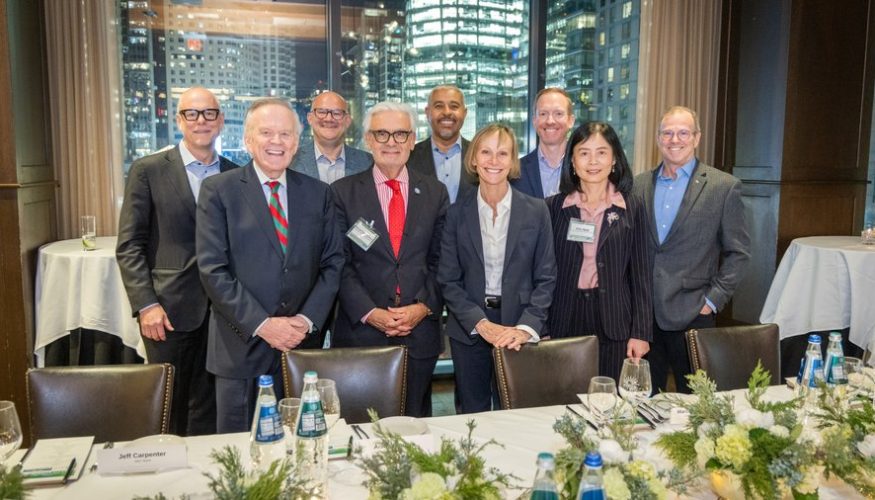
Boston Business Journal Local Market President and Publisher Carolyn Jones helped gather a group of business, healthcare, tech, education and advocacy leaders for an engaging discussion on the region’s business landscape, opportunities for growth and strategies to strengthen Boston’s position amid a challenging environment.
Chris Kay, Senior Executive Vice President and Head of Enterprise Platforms at M&T Bank, co-hosted the roundtable, helping to facilitate the discussion and bring together a distinguished group of leaders. Joining him in the conversation was:
- Chris Anderson, President, MassHighTech Council
- Jim Brett, President & CEO, New England Council
- Jeff Carpenter, Interim Regional President/Head of Specialty and Corporate Banking, M&T Bank
- Brian Johnson, President, MassMedic
- Grace Lee, President & CEO, SMCU
- Manny Lopes, President & CEO, Fallon Health
- Marcelo Suarez-Orozco, Chancellor, University of Massachusetts Boston
- Amy Zeng, Dean, Sawyer Business School at Suffolk University
Of two minds
Recent federal policy changes have introduced challenges – fewer grants, shifts in lab operations and a drop in international student enrollment. These changes are driving the region to find fresh, innovative ways to strengthen its education economy.
Meanwhile, fast-growing regions like the Carolinas and Dallas-Fort Worth are making bold moves to attract business and innovation—highlighting the need for Boston to take proactive steps that will secure its leadership position for generations to come.
“Boston does well in research and development, but we can’t rest on those laurels,” says Jim Brett, president and CEO of the New England Council, a regional business association. “We need to find ways to be more competitive, keep what we have here and regroup through challenging times.”
University of Massachusetts Boston Chancellor Marcelo Suarez-Orozco says his school has seen a 30 percent reduction in overseas students this year, but remains hopeful that what he calls the city’s “cultural and locational endowment” will provide a solution. Boston should lean into the ideals that leaders want to embody in their organizations.
“We are the existential partner in the domains that matter most. There was nothing pre-ordained about Boston taking the lead in life sciences the way it did,” Suarez-Orozco says, later quoting Wayne Gretzky. “It was scaffolded, nurtured and cultivated. We need to skate to where the puck is going to be, not where it is now.”
A path forward
For SMCU president and CEO Grace Lee, the future is about leaning into the principles that have made Boston a worldwide leader. She highlighted mixed-use development Winthrop Center, which is widely considered the most energy-efficient large-scale office building ever constructed in a cold climate as an example of how progressive thinking can be good for business. The development has attracted local firms and international government venture capital funds.
“While we are looking inside, external audiences see us as leaders,” Lee says. “How we behave and react is meaningful.”
While embodying ideals is essential, other leaders want to see more action on the front lines of business development. While billions have been spent supporting the biotech and pharma industries in Boston over the last few decades, MassHighTech Council’s Chris Anderson would like to see more private-sector leadership advocating for growth-forward policies that can impact who makes the rules in the region. “We need to reduce the cost of business in Massachusetts,” he says. “We can’t be just cheerleaders. We need to block and tackle.”
Cultural competence
The Greater Boston region has some infrastructural advantages, but its culture of caring for the vulnerable, providing health insurance and leading in equity can also help it tap into the next generation of business leaders, who are more invested in the connection between their work and their values than previous iterations. Health insurance firm Fallon Health’s CEO, Manuel Lopes, sees an opportunity for Massachusetts organizations to flip the “no margin, no mission” maxim on its head.
“People come to work thinking about how they get attached and engaged,” he says. “Massachusetts is in line to show the rest of the country and globe that we can attract the next generation of intellectuals, innovators, designers and future leaders like no one else can.”
The discussion left the group inspired to continue the conversation, prompting M&T Bank senior executive vice president and head of enterprise platforms Chris Kay to extend an invitation and offer a provocation. “This thoughtful, soulful group needs to pick one thing to work on together,” Kay said, offering an opportunity to continue the dialogue. “It always comes down to humanity, talent, people and relationships. I am bold on Boston, and it is because of the people.”