Hassan: Doubts GOP leaders in Congress will do deep dive on Iran War strategy
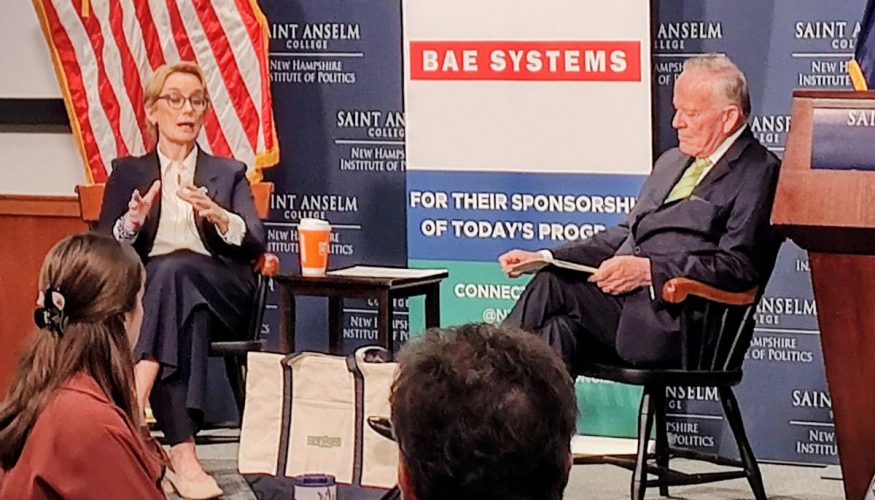
By Kevin Landrigan, Union Leader
U.S. Sen. Maggie Hassan, D-N.H., said she’s pessimistic that the Republican-led Congress, prior to the midterm elections, will do a deep dive to examine what she has dubbed President Donald Trump’s unnecessary war with Iran even if a tentative agreement to end the conflict comes to pass.
“I would hope that our Republican colleagues would want to review the deal as well as how it is that the president decided to take us into a war without the consent of the public that cost us so much in terms of lives, credibility and treasure,” Hassan said during an interview.
“I’m also not confident that before the election that my colleagues on the other side of the aisle will be interested in doing that which is frustrating because so many Americans from both political perspectives really opposed this war.”
During remarks before the New England Council, Hassan said it doesn’t appear Trump accomplished his main objectives when the U.S. and Israel first attacked Iran in February.
“It is an extraordinarily troubling set of events that he took us to war when we didn’t need to go to war,” Hassan said at the New Hampshire Institute of Politics.
On Monday, Trump said at the opening of a meeting with G7 nation leaders in France that he would reject an offer from Great Britain and France that they head up a force that ensures the free flow of oil and gas through the Strait of Hormuz.
“I think a lot of great things are going to happen in the Middle East right now. And very importantly, the oil is plummeting down and the stock market is shooting up like a rocket today,” Trump said. “The main thing is that Iran will not have a nuclear weapon. They fully agreed to that with strong policing powers, and they won’t have a nuclear weapon, which is what it was all about.”
Both U.S. and Iranian officials admit this agreement to be signed in Switzerland Friday does not resolve the future of Iran’s nuclear program and the desire of the U.S. to take out of that country uranium that has been stockpiled there.
Congress has only six weeks to accomplish major legislation before its August recess; there’s likely to be few concrete achievements from September when they return until after the midterm elections in November, Hassan said.
Hassan said her top priorities for the remainder of the year are to pass a bipartisan housing bill, the defense department’s budget measure and health care reforms that include closing one loophole Big Pharma firms use to extend their patents on medications which keep prices artificially high.
She’s also pursuing material health legislation that would use federal grants to train all hospital emergency room staffers so they can deal with a crisis pregnancy.
“New Hampshire has lost about a dozen maternity wards in past 20 years and now more women have to drive at least an hour to get to maternal care and delivery,” Hassan said.
On other topics:
• Rural health transformation: Hassan called the $204 million GO-NORTH program “a tiny step forward after nine steps backward” since the Trump-directed future cuts to Medicaid are nine times what the state is receiving from this grant.
• First-in-the-nation primary case: Hassan said New Hampshire will keep the first presidential primary thanks to its protective state law, but she declined to hazard a guess whether the Democratic National Committee’s Rules and By-Laws panel this summer will move to restore the Granite State’s top place on the primary calendar for 2028.
• ICE/Border Patrol reforms: Hassan hopes the Senate leadership revives bipartisan talks that had been promising a few months back to set guardrails for Immigration and Custom Enforcement and Border Patrol that other law enforcement agencies abide by, such as judicial warrants to enter a home and requiring those scooping up potential detainees to wear body cameras and ID tags but no masks.